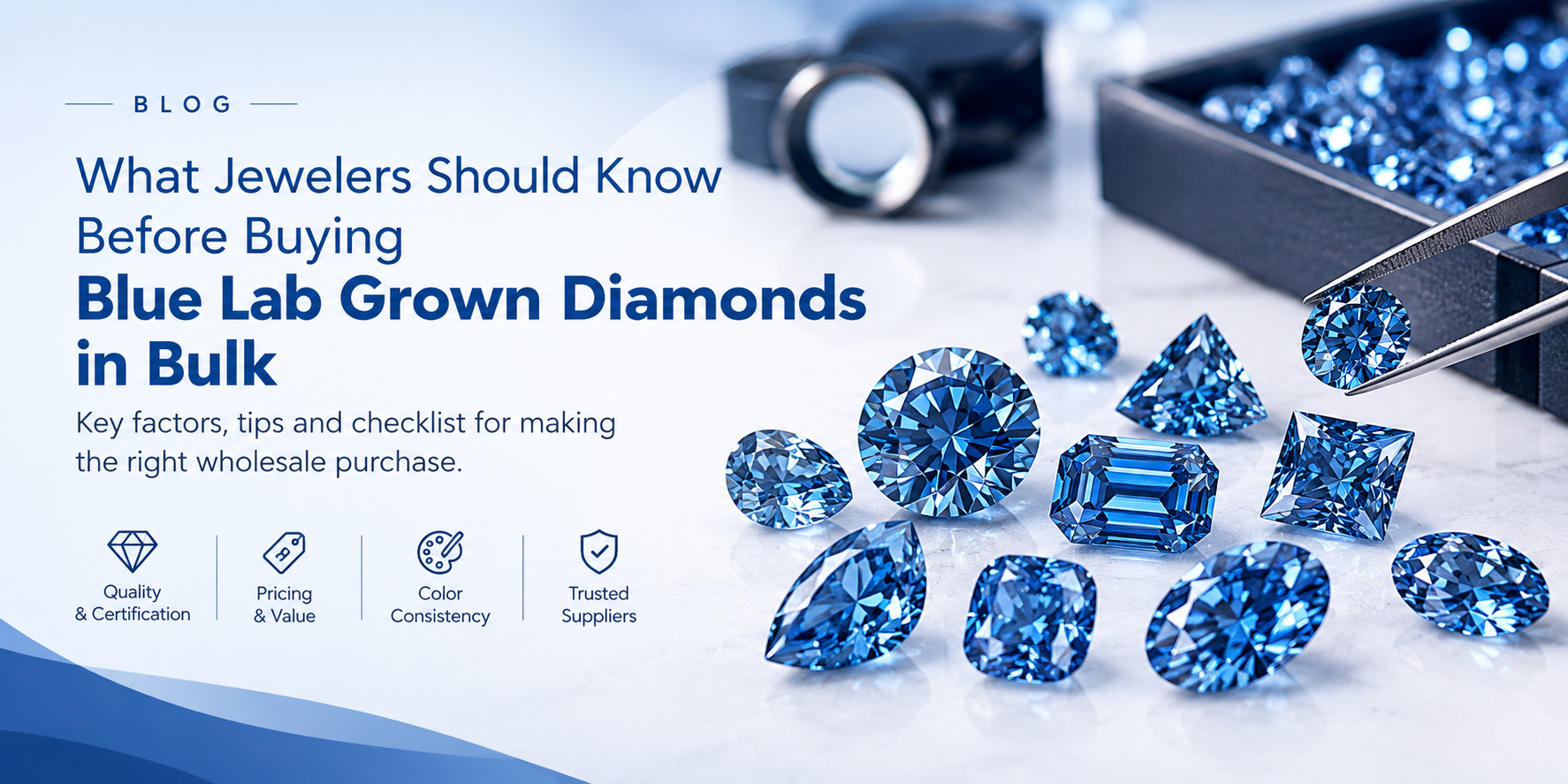
Buying blue lab grown diamonds in bulk can be an important sourcing decision for jewelers, jewelry manufacturers, wholesalers, and retailers. When purchasing a few individual stones, it may be relatively easy to compare appearance and specifications. Bulk purchasing is different because consistency, availability, documentation, pricing, quality control, and delivery become equally important.
Blue lab grown diamonds are available in different shapes, sizes, color intensities, and quality grades. However, not every supplier will offer the same specifications or consistency from one batch to another. For this reason, jewelers should evaluate both the diamonds and the supplier before committing to a large wholesale order.
Whether you are developing a new jewelry collection, supplying retail stores, or purchasing stones for ongoing manufacturing, understanding the key factors involved can help make the buying process more organized and predictable.
What Are Blue Lab Grown Diamonds?
Blue lab grown diamonds are diamonds created using laboratory-based diamond-growth technologies and exhibiting blue coloration. They have the crystalline structure associated with diamond, while their color characteristics depend on the growth process and, in some cases, subsequent treatment.
Common laboratory diamond-growth technologies include Chemical Vapor Deposition (CVD) and High Pressure High Temperature (HPHT). The characteristics of the resulting diamond can vary depending on the growth conditions, processing, and treatment.
For jewelers, the most important point is to understand exactly what they are purchasing. Before placing a bulk order, ask the supplier about the diamonds’ growth method, color origin, treatments, grading documentation, and product specifications.
Why Are Jewelers Buying Blue Lab Grown Diamonds in Bulk?
Bulk purchasing can be useful when a jewelry business requires multiple stones with defined specifications.
For example, a manufacturer producing a collection of blue-diamond rings may need stones within a particular:
- Carat-weight range
- Shape
- Color range
- Clarity range
- Size range
- Matching specification
Buying according to a consistent specification can simplify production and inventory management.
Blue lab grown diamonds can also be incorporated into different types of jewelry, including:
- Engagement rings
- Fashion rings
- Earrings
- Pendants
- Necklaces
- Bracelets
- Custom jewelry
- Designer collections
The appropriate specifications will depend on the design, target customer, price positioning, and manufacturing requirements.
1. Define Your Requirements Before Contacting a Supplier
One of the most important steps in bulk purchasing is knowing exactly what you need.
Instead of telling a supplier that you simply need “blue lab grown diamonds,” prepare a specification sheet.
Your specification may include:
| Requirement | Example |
|---|---|
| Shape | Round, Oval, Cushion, Pear |
| Carat | Specific range |
| Color | Defined blue range |
| Clarity | Required clarity range |
| Cut | Preferred cut quality |
| Quantity | Number of stones |
| Matching | Required for pairs or collections |
| Certification | Required or optional |
| Delivery | Required date |
A detailed specification allows suppliers to provide more accurate quotations and helps you compare different suppliers on the same basis.
2. Understand Blue Color Characteristics
Color is one of the most important considerations when buying blue diamonds.
Two diamonds can both be described as blue but have noticeably different appearances. Differences can occur in:
- Hue
- Tone
- Saturation
- Color intensity
- Color distribution
For jewelry manufacturers, these differences matter because a collection may look inconsistent if the stones have significantly different blue characteristics.
Ask for Representative Samples
Before placing a large order, request photographs, videos, or physical samples where appropriate. However, remember that screen displays and lighting can change the appearance of colored diamonds.
For important purchases, physical inspection or professional evaluation can provide a better basis for comparison.
3. Check the Diamond’s Growth Method
Ask your supplier whether the diamonds are produced using:
- CVD technology
- HPHT technology
- Another laboratory-growth process
The growth method itself should not be the only factor used to judge a diamond. Instead, buyers should understand how the method relates to the product they are purchasing.
Ask the supplier for clear information about:
- Growth method
- Production specifications
- Post-growth treatment
- Color origin
- Grading documentation
This information is particularly important for businesses that need to accurately describe their products to customers.
4. Understand Whether the Color Is Treated
One of the most important questions to ask a supplier is whether the blue color is associated with the diamond’s growth process or has been introduced or modified through post-growth treatment.
Treatment information should be clearly disclosed.
For B2B buyers, this matters because treatment can affect how the product should be represented, documented, and marketed.
Do not assume that two blue lab grown diamonds with similar appearances have been produced or treated in exactly the same way.
5. Pay Attention to the 4Cs
The traditional 4Cs—Cut, Color, Clarity, and Carat Weight remain useful when evaluating diamonds, but colored lab grown diamonds require additional attention to color characteristics and documentation.
Cut
Cut affects how the diamond interacts with light and contributes to its visual appearance.
For manufacturing, consistent proportions and dimensions can also be important when multiple stones are being set into similar designs.
Color
For blue diamonds, color deserves particular attention.
Define the desired blue range before ordering so that the supplier knows exactly what you are looking for.
Clarity
Clarity describes internal and external characteristics. The appropriate clarity level depends on the stone’s size, design, intended market, and budget.
Carat Weight
Carat weight is important for inventory planning, but it does not completely determine how large a diamond appears. Shape, proportions, and measurements also influence visual size.
6. Certification and Grading Reports
Certification and grading documentation can help buyers verify important information about individual diamonds.
Depending on the laboratory and report, documentation may include details such as:
- Laboratory-grown origin
- Shape
- Measurements
- Carat weight
- Color
- Clarity
- Cut or proportions
- Treatments or other characteristics
Before placing a bulk order, ask:
- Who graded the diamonds?
- What information appears on the report?
- Does each diamond receive an individual report?
- Are reports available for the specific stones being purchased?
The documentation requirements can vary depending on the buyer’s market, product range, and sales channels.
7. Compare Wholesale Pricing Carefully
Price is naturally important when purchasing diamonds in bulk, but the lowest quotation does not necessarily represent the best commercial value.
Wholesale pricing can depend on several factors:
- Carat weight
- Color
- Clarity
- Cut
- Shape
- Certification
- Treatment
- Quantity
- Matching requirements
- Custom specifications
- Production availability
When comparing quotations, make sure the specifications are equivalent.
For example, comparing the price of one supplier’s certified blue diamonds with another supplier’s stones that have different specifications may produce a misleading comparison.
Ask for a Detailed Quotation
A professional quotation should clearly identify:
- Product specifications
- Quantity
- Price per stone or carat
- Total order value
- Certification costs, if applicable
- Shipping costs
- Taxes or duties where applicable
- Payment terms
- Delivery timeline
This helps avoid misunderstandings later.
8. Minimum Order Quantity Matters
Different wholesale suppliers have different minimum order requirements.
Before starting a business relationship, ask about the supplier’s:
MOQ – Minimum Order Quantity.
A manufacturer may be comfortable ordering hundreds of stones, while a smaller jewelry retailer may need a smaller batch.
If the supplier’s MOQ is too high for your business, you may end up holding excess inventory.
Discuss whether the supplier offers:
- Small trial orders
- Mixed-size orders
- Mixed-shape orders
- Custom quantities
- Repeat-order programs
9. Consistency Is Critical for Bulk Orders
Consistency is one of the biggest differences between buying individual diamonds and buying in bulk.
Imagine ordering 200 blue diamonds for a jewelry collection. If the first 100 stones have a particular blue appearance and the next 100 have noticeably different color characteristics, the finished collection may not look consistent.
Ask suppliers about their ability to maintain consistency in:
- Color
- Shape
- Size
- Carat weight
- Cut
- Clarity
- Matching
For large production programs, establish written specifications that can be used for future orders.
10. Quality Control Before Shipment
Ask how the supplier checks diamonds before dispatch.
Quality control may include verification of:
- Carat weight
- Measurements
- Shape
- Color
- Clarity
- Cut
- Matching
- Grading reports
- Packaging
The exact process will vary by supplier.
For high-volume buyers, it may also be useful to establish an agreed inspection process before shipment.
11. Ask About Matching Pairs and Sets
Matching becomes particularly important when purchasing diamonds for:
- Earrings
- Matching rings
- Tennis bracelets
- Multi-stone necklaces
- Coordinated collections
If you need matching stones, don’t simply specify the same carat weight.
Specify what you mean by “matching.”
For example:
- Similar measurements
- Similar color
- Similar clarity
- Similar cut
- Similar proportions
A professional supplier should understand these requirements before production or sourcing begins.
12. Check Inventory and Production Capacity
Before placing a large order, ask whether the supplier has the stones in stock or needs to produce/source them.
This can affect delivery time.
Ask:
- Is the required quantity currently available?
- How long will production take?
- Can the supplier repeat the same specifications later?
- What happens if some specifications are unavailable?
- Can the supplier maintain supply for future orders?
This is especially important for jewelry brands planning long-term collections.
13. Consider Shipping and Packaging
Bulk diamond shipments require secure and well-documented handling.
Before ordering, discuss:
- Shipping method
- Insurance
- Packaging
- Tracking
- Delivery timeline
- Export documentation
- Import requirements
- Customs responsibilities
For international B2B purchases, the buyer and supplier should clearly understand who is responsible for each part of the shipping process.
Importers should also verify the applicable requirements in their destination country.
14. Understand Payment Terms
Payment terms can significantly affect cash flow.
Suppliers may have different requirements for:
- Advance payments
- Partial payments
- Balance payments
- Payment on shipment
- Bank transfers
- Other accepted payment methods
Before placing the order, make sure all payment conditions are documented.
For a new supplier relationship, consider starting with an appropriately sized trial order before moving to larger recurring purchases.
15. Review Return and Replacement Policies
Bulk orders should have clear procedures for dealing with problems.
Ask the supplier:
- What happens if stones arrive damaged?
- What if the specifications don’t match the purchase order?
- What if documentation is incorrect?
- What is the inspection period?
- Are customized orders returnable?
- How are replacement stones handled?
Clear policies protect both the buyer and supplier.
16. Choose a Supplier With Strong Communication
Good communication is often overlooked when comparing suppliers.
A reliable blue lab grown diamond supplier should be able to communicate clearly about:
- Product availability
- Specifications
- Pricing
- Production
- Documentation
- Shipping
- Order changes
For international buyers, communication becomes even more important because differences in terminology and commercial practices can create misunderstandings.
17. Build a Long-Term Supplier Relationship
For jewelry manufacturers and wholesalers, sourcing is rarely a one-time activity.
If you regularly require wholesale blue lab grown diamonds, developing a long-term supplier relationship can make purchasing easier.
A good relationship can help with:
- Repeat orders
- Consistent specifications
- Production planning
- Custom requirements
- Inventory planning
- New product development
However, buyers should continue to verify specifications and documentation rather than assuming future batches will automatically be identical.
Questions Jewelers Should Ask Before Buying in Bulk
Here is a practical checklist to use when speaking with a supplier:
- What blue shades and color ranges are available?
- Are the diamonds CVD or HPHT grown?
- Is the blue color associated with growth or post-growth treatment?
- What grading reports are available?
- Can you provide samples?
- What is the minimum order quantity?
- Can you provide matching stones?
- What shapes and carat ranges are available?
- How do you maintain color consistency?
- What quality-control process do you use?
- What is the production lead time?
- Can you support repeat orders?
- What are your payment terms?
- What are your shipping and insurance terms?
- What is your replacement or return policy?
Getting these answers before ordering can reduce the possibility of unexpected issues.
Common Mistakes to Avoid When Buying Blue Lab Grown Diamonds Wholesale
Choosing Only on Price
A low price may reflect different specifications, documentation, treatment, or commercial terms. Always compare equivalent products.
Ordering Too Much Too Quickly
A large first order can create unnecessary inventory risk. Consider an appropriate trial order when establishing a new supplier relationship.
Ignoring Color Consistency
Blue diamonds can vary visually. Make color consistency part of your purchasing specification.
Not Checking Documentation
Always understand what documentation accompanies the stones and what information it verifies.
Failing to Define Specifications
A vague purchase request can result in inconsistent products. Create a clear specification sheet.
Not Discussing Future Supply
If you are building a long-term collection, ask whether the supplier can support repeat orders with similar specifications.
Final Checklist for Bulk Buyers
Before confirming your order, review these points:
- Product specifications confirmed
- Blue color range defined
- Growth method understood
- Treatment information disclosed
- 4Cs requirements confirmed
- Grading documentation verified
- Quantity confirmed
- Matching requirements confirmed
- MOQ understood
- Wholesale price confirmed
- Production timeline confirmed
- Quality-control process discussed
- Shipping and insurance confirmed
- Payment terms documented
- Return/replacement terms understood
Conclusion
Buying blue lab grown diamonds in bulk requires careful planning. For jewelers, manufacturers, wholesalers, and retailers, the right sourcing decision involves much more than finding an attractive price. Product specifications, blue color characteristics, growth method, treatment disclosure, grading documentation, consistency, quality control, quantity, delivery, and commercial terms all deserve attention.
When evaluating a Blue Lab Grown Diamonds Wholesale Supplier, define your requirements first, compare suppliers using the same specifications, request appropriate documentation and samples, and establish clear expectations for quality and delivery.
A transparent and capable supplier can become a valuable part of your jewelry supply chain, helping you source Blue Lab Grown Diamonds Wholesale according to your business requirements and develop consistent collections for your customers.
FAQs
1. What Should Jewelers Check Before Buying Blue Lab Grown Diamonds in Bulk?
Jewelers should check diamond quality, color consistency, cut, clarity, carat weight, certification, pricing, availability, and the supplier’s quality-control process before placing a bulk order.
2. Are Blue Lab Grown Diamonds Suitable for Wholesale Jewelry Businesses?
Yes. Blue lab grown diamonds can be used in various jewelry designs, including engagement rings, earrings, pendants, bracelets, and custom pieces. Bulk purchasing can help jewelers maintain inventory for different designs and customer requirements.
3. How is the Quality of Blue Lab Grown Diamonds Evaluated?
Quality is generally evaluated using factors such as the 4Cs – cut, clarity, color, and carat weight – along with the diamond’s specific blue hue, treatment status, growth method, and grading documentation.
4. Do Blue Lab Grown Diamonds Come with Certification?
Many lab grown diamonds are available with grading reports from recognized gemological laboratories. Jewelers should verify that the report matches the diamond and clearly describes its laboratory-grown origin and relevant characteristics.
5. What affects the Wholesale Price of Blue Lab Grown Diamonds?
Wholesale pricing can depend on carat weight, color intensity, clarity, cut quality, shape, certification, order quantity, and supplier terms. Prices can also vary based on market conditions and production costs.
6. Why is Color Consistency Important When Buying Blue Lab Grown Diamonds in Bulk?
Color consistency is important when multiple diamonds will be used in matching jewelry pieces, collections, pairs, or sets. Jewelers should discuss acceptable color ranges with the supplier before ordering.
7. What Shapes of Blue Lab Grown Diamonds Can Jewelers Buy in Bulk?
Common options include round, oval, emerald, cushion, pear, princess, radiant, marquise, and other customized shapes. Availability depends on the supplier and production requirements.
8. What is the Minimum Order Quantity (MOQ) for Bulk Purchases?
MOQ varies from supplier to supplier. Some wholesalers may offer flexible quantities, while others may require a specific minimum carat weight, number of stones, or order value.
9. How can Jewelers Verify a Wholesale Diamond Supplier?
Jewelers can review certifications, product samples, quality-control procedures, business credentials, customer reviews, return or replacement policies, shipping terms, and communication practices before committing to a large order.
10. Can Jewelers Request Matching Blue Lab Grown Diamonds?
Yes, jewelers can ask suppliers for matched pairs, sets, or batches with similar specifications. It is important to provide clear requirements for size, shape, color, clarity, and cut.
11. Should Jewelers Order Samples Before Buying in Bulk?
Ordering samples can help jewelers evaluate the actual color, cut, clarity, finish, and consistency of the diamonds before making a larger purchase.
12. What Should Jewelers ask a Supplier Before Placing a Bulk Order?
Jewelers should ask about diamond specifications, certification, pricing, MOQ, production capacity, color consistency, lead time, shipping, payment terms, return/replacement policies, and after-sales support.
13. How should Blue Lab Grown Diamonds Be Packaged for Wholesale Shipping?
Diamonds should be securely packaged and individually identified where appropriate. The supplier should use packaging that protects the stones from damage or loss during transportation.
14. Can Blue Lab Grown Diamonds be Customized for Specific Jewelry Designs?
Depending on the supplier’s capabilities, jewelers may be able to request specific shapes, sizes, color ranges, and other specifications to match their jewelry designs or collection requirements.
15. What is the Most Important Factor When Buying Blue Lab Grown Diamonds in Bulk?
There is no single factor that applies to every purchase. Jewelers should consider quality, consistency, certification, pricing, supplier reliability, and order requirements together to ensure the diamonds meet their business and product needs.