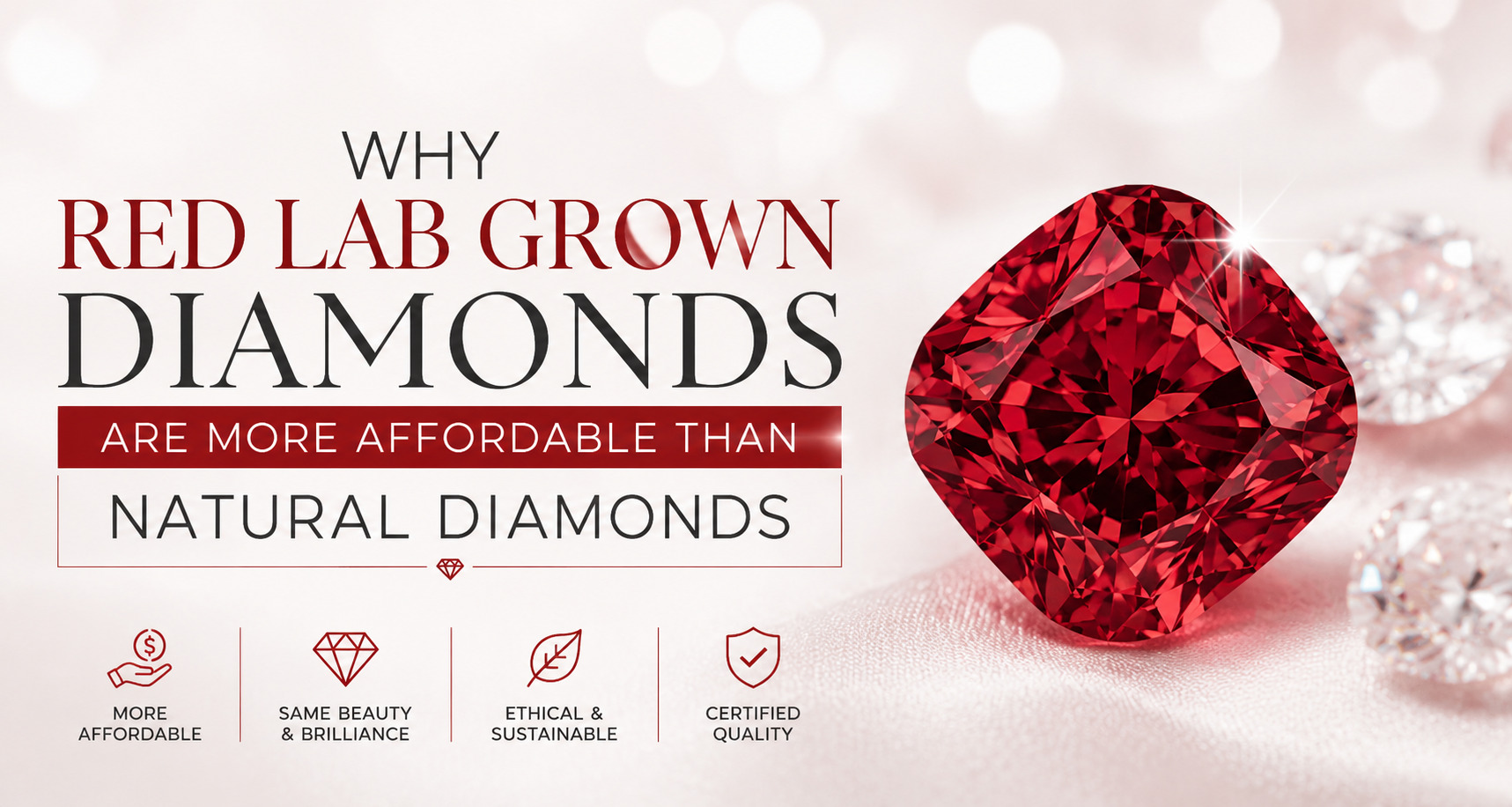
Red diamonds are admired for their intense color, extraordinary beauty, and exceptional rarity. Their deep red appearance makes them one of the most desirable choices for engagement rings, luxury jewellery, pendants, earrings, and statement pieces.
However, natural red diamonds are among the rarest gemstones found on Earth. Their limited availability can make them extremely expensive and inaccessible to many jewellery buyers. This is where red lab grown diamonds offer an attractive alternative.
Lab grown red diamonds provide the beauty, brilliance, and luxurious appearance of colored diamonds at a significantly more accessible price. But why are red lab grown diamonds more affordable than natural red diamonds?
The main difference lies in how they are created, how rare they are, and the costs involved in bringing them to the jewellery market.
What Is a Red Lab Grown Diamond?
A red lab grown diamond is a genuine diamond created in a controlled laboratory environment rather than mined from beneath the Earth.
Advanced technologies such as:
- Chemical Vapour Deposition (CVD)
- High Pressure High Temperature (HPHT)
are commonly used to create laboratory-grown diamonds.
Lab grown diamonds are not the same as imitation stones such as colored glass or cubic zirconia. They possess the chemical, physical, and optical characteristics associated with diamonds. Professional laboratories use specialised equipment to distinguish laboratory-grown diamonds from natural diamonds.
Red colour may develop during the growth process or through additional color-enhancement techniques. Modern diamond technology makes it possible to produce laboratory-grown diamonds in many colors, including pink, blue, yellow, green, and red.
Why Are Natural Red Diamonds So Expensive?
The high value of natural red diamonds is primarily connected to their extreme rarity.
Natural diamonds take billions of years to form deep beneath the Earth under intense heat and pressure. Among these diamonds, only a very small number develop a strong natural red color.
According to GIA research, pure Fancy red diamonds represent approximately 0.04% of fancy-color diamonds submitted to GIA, making them exceptionally uncommon.
Unlike more commonly available yellow or brown diamonds, natural red diamonds are rarely discovered in larger sizes. Pure red diamonds without noticeable purple, orange, or brown secondary tones are even more difficult to find.
Because demand is high and supply is extremely limited, natural red diamonds may command extraordinary prices.
Why Red Lab Grown Diamonds Are More Affordable
1. They Do Not Depend on Natural Geological Rarity
Natural red diamonds can only be obtained when rare geological conditions produce the correct color characteristics over an extremely long period.
Lab grown diamonds do not depend on the discovery of a rare natural deposit. Diamond-growing technology allows manufacturers to create diamonds in controlled environments.
Although producing a high-quality red lab grown diamond may still require advanced knowledge and specialized equipment, manufacturers are not limited to the small number of red diamonds naturally available beneath the Earth.
This greater availability reduces the extreme rarity premium associated with natural red diamonds.
2. Laboratory Production Creates a More Predictable Supply
Natural diamond mining involves exploration, extraction, sorting, transportation, and processing. Even after significant investment, there is no guarantee that a mine will produce a high-quality natural red diamond.
Manufacturers can monitor important conditions during diamond growth and improve their methods over time. This creates a more predictable supply compared with waiting for an extremely rare natural red diamond to be discovered.
A more reliable supply generally makes red lab grown diamonds accessible to a wider range of jewellery buyers.
3. There Are Fewer Mining-Related Costs
Natural diamonds pass through several stages before reaching the customer, including:
- Geological exploration
- Mine development
- Diamond extraction
- Rough diamond sorting
- Transportation
- Cutting and polishing
- Grading and distribution
Mining operations can require significant infrastructure, labor, machinery, and investment.
Lab grown diamonds are produced in specialized facilities. They still require advanced technology, energy, skilled professionals, cutting, polishing, and grading, but many costs associated specifically with large-scale mining are not part of the production process.
As a result, the final retail price may be considerably lower.
4. Natural Red Diamonds Carry a Major Rarity Premium
The price of a natural red diamond is not based only on its size or beauty.
Collectors may also pay for:
- Natural origin
- Exceptional rarity
- Historical significance
- Limited worldwide availability
- Long-term collectability
- Auction demand
Natural fancy color diamonds generally become more valuable as their colour becomes stronger and purer. Large diamonds with vivid fancy colors are particularly rare and valuable.
Lab grown red diamonds are valued differently because their supply is not restricted by the same geological rarity.
Therefore, buyers can enjoy a vibrant red diamond appearance without paying the exceptionally high premium attached to a rare natural origin.
5. Technology Has Improved Diamond Production
Advancements in CVD and HPHT technology have improved the efficiency and quality of laboratory-grown diamond production.
Manufacturers can create larger and higher-quality diamonds more consistently than was possible during the early years of the industry.
GIA identifies HPHT and CVD as the two primary laboratory diamond growth processes and continues to study improvements in laboratory-grown diamond technology.
As technology develops and production becomes more efficient, lab grown diamonds can become more widely available.
Greater availability and production efficiency help make red lab grown diamonds more affordable than rare natural red diamonds.
6. Color Can Be Created or Improved in Controlled Conditions
Natural red color is extremely difficult to find. In laboratory-grown diamonds, manufacturers have greater control over the growth environment and may use specialized processes to influence or enhance color.
Some lab grown diamonds receive post-growth treatment to modify their color appearance. When purchasing a diamond, buyers should review the grading report to understand whether treatment has been used.
The ability to create desirable colors through controlled technology makes red-colored diamonds more accessible without depending entirely on rare natural formation.
Are Red Lab Grown Diamonds Real Diamonds?
Yes, lab grown diamonds are real diamonds.
They should not be confused with diamond alternatives such as:
- Cubic zirconia
- Coloured glass
- Crystal
- Moissanite
A laboratory-grown diamond is created using advanced technology that reproduces the conditions required for diamond crystal growth.
Lab grown diamonds may display the brilliance, hardness, sparkle, and visual characteristics expected from diamonds. Specialised gemological testing is generally required to reliably identify their origin.
However, sellers should clearly disclose that a diamond is laboratory-grown, laboratory-created, or lab created so customers understand that it is not a mined natural diamond.
Natural Red Diamond vs Red Lab Grown Diamond
| Feature | Natural Red Diamond | Red Lab Grown Diamond |
|---|---|---|
| Origin | Formed naturally beneath the Earth | Created in a controlled laboratory |
| Availability | Extremely rare | More widely available |
| Price | Exceptionally expensive | Comparatively affordable |
| Appearance | Natural red color | Can offer a similar red appearance |
| Diamond properties | Diamond | Diamond |
| Production time | Forms naturally over billions of years | Produced using advanced technology |
| Collectable rarity | Very high | Generally lower |
| Suitable for everyday jewellery | Limited by high cost | More accessible for jewellery buyers |
Are Red Lab Grown Diamonds Cheap?
Red lab grown diamonds are more affordable than natural red diamonds, but that does not necessarily mean they are cheap.
The final price may depend on:
- Carat weight
- Colour intensity
- Colour distribution
- Clarity
- Cut quality
- Diamond shape
- Certification
- Manufacturing complexity
- Jewellery design
- Metal type
A large Fancy Vivid red lab grown diamond with excellent clarity and cutting may still cost more than a smaller or less intensely colored lab grown diamond.
However, its price is generally expected to remain much lower than that of an equally impressive natural red diamond because it does not carry the same geological rarity premium.
Benefits of Choosing a Red Lab Grown Diamond
More Accessible Pricing
Buyers may be able to purchase a larger or more intensely colored diamond within the same jewellery budget.
Luxurious Red Appearance
Red lab grown diamonds offer a bold and distinctive appearance suitable for modern and luxury jewellery.
More Design Options
Affordable pricing may allow customers to explore larger centre stones, diamond halos, customized rings, or elaborate jewellery settings.
Suitable for Modern Jewellery
Red lab grown diamonds can be used in:
- Engagement rings
- Anniversary rings
- Cocktail rings
- Diamond pendants
- Earrings
- Bracelets
- Custom luxury jewellery
Clear Origin Information
Certified laboratory-grown diamonds can include grading information about their origin, measurements, colour, clarity, and other quality characteristics.
What to Check Before Buying a Red Lab Grown Diamond
Before purchasing, consider the following factors.
Check the Color Grade
Look at the intensity and evenness of the red colour.
Some diamonds may contain secondary tones such as:
- Purplish red
- Orangy red
- Brownish red
- Pinkish red
Choose a shade that matches your jewellery style and personal preference.
Review the Diamond Certificate
Purchase from a trusted seller and review the grading report when available.
A professional diamond report may provide details such as:
- Laboratory-grown origin
- Carat weight
- Diamond shape
- Measurements
- Color description
- Clarity grade
- Cut information
- Treatment disclosure
Compare the Diamond in Different Lighting
The appearance of a coloured diamond may change under daylight, warm indoor lighting, and jewellery showroom lighting.
View the diamond under different light sources whenever possible.
Choose the Right Jewellery Metal
The surrounding metal can influence how the red color appears.
Popular options include:
Rose gold for a warm and romantic look
Yellow gold for a rich traditional appearance
White gold for stronger colour contrast
Platinum for a modern luxury design
Buy From a Reputable Jewellery Brand
Choose a seller that clearly describes the diamond as laboratory-grown and provides transparent information about certification, treatment, returns, and jewellery quality.
Are Red Lab Grown Diamonds Worth Buying?
A red lab grown diamond may be worth considering for buyers who prioritise:
- Attractive red color
- Diamond brilliance
- Larger size
- Modern jewellery
- Better affordability
- More design flexibility
Natural red diamonds may appeal more to collectors searching for exceptional geological rarity and long-term collectability.
For jewellery lovers who mainly want beauty, color, brilliance, and an accessible price, a red lab grown diamond can provide excellent value.
Conclusion
Red lab grown diamonds are more affordable than natural red diamonds because they do not depend on the discovery of an exceptionally rare natural gemstone.
Controlled laboratory production creates a more predictable supply, reduces many mining-related expenses, and removes much of the geological rarity premium attached to natural red diamonds.
Natural red diamonds remain extraordinary because of their scarcity, unique natural origin, and collectable value. However, their limited availability makes them unaffordable for many buyers.
Red lab grown diamonds provide a modern alternative by offering beautiful red colour, diamond brilliance, and greater design possibilities at a more accessible price.
For buyers who want the luxurious appearance of a red diamond without paying the extraordinary price associated with natural rarity, a certified red lab grown diamond can be an attractive choice.
FAQs
1. What is a Red Lab Grown Diamond?
A red lab grown diamond is a real diamond created in a laboratory using advanced technologies like CVD or HPHT. It has the same physical, chemical, and optical properties as a natural diamond.
2. Why are Red Lab Grown Diamonds Cheaper than Natural Red Diamonds?
Red lab grown diamonds are more affordable because they are produced in controlled laboratory conditions, have a more predictable supply, and do not carry the extreme rarity premium of natural red diamonds.
3. Are Red Lab Grown Diamonds Real Diamonds?
Yes. Red lab grown diamonds are genuine diamonds, not diamond simulants like cubic zirconia or moissanite.
4. Do Red Lab Grown Diamonds Look like Natural Red Diamonds?
Yes. High-quality red lab grown diamonds offer brilliant sparkle, rich red color, and an appearance that is very similar to natural red diamonds.
5. How are Red Lab Grown Diamonds Made?
They are created using advanced technologies such as Chemical Vapor Deposition (CVD) and High Pressure High Temperature (HPHT), which replicate the natural diamond-growing process.
6. Are Red Lab Grown Diamonds Durable?
Yes. Like natural diamonds, lab grown diamonds have a hardness of 10 on the Mohs scale, making them suitable for everyday jewellery.
7. Can Red Lab Grown Diamonds be Certified?
Yes. Many red lab grown diamonds are certified by respected gemological laboratories, which provide details about their origin, color, clarity, cut, and carat weight.
8. What Affects the Price of a Red Lab Grown Diamond?
The price depends on factors such as carat weight, colour intensity, clarity, cut quality, shape, certification, and overall craftsmanship.
9. What Jewellery Can be made with Red Lab Grown Diamonds?
Red lab grown diamonds are commonly used in engagement rings, earrings, pendants, bracelets, cocktail rings, and custom luxury jewellery.
10. Are Red Lab Grown Diamonds a Good Choice for Engagement Rings?
Yes. They offer stunning beauty, excellent durability, and a more affordable price, making them a popular choice for modern engagement rings.
11. How can I identify a Red Lab Grown Diamond?
A certified grading report from a recognized gemological laboratory is the most reliable way to identify a lab grown diamond.
12. Where can I Buy Certified Red Lab Grown Diamonds?
You should purchase from a trusted and reputable lab grown diamond manufacturer or jewellery brand that provides certification, transparent product details, and quality assurance.